


Want recurring messages in Google Chat — daily standups, weekly reminders, sprint check-ins? Google Chat's built-in scheduler (rolled out December 2025) only handles one-off sends, so anything that repeats needs a third-party tool. The fastest path is Schedule Message from the Google Workspace Marketplace: install it, type /schedule in any space, write the message, pick a recurrence (every weekday at 9 AM, every Monday, every two weeks), and walk away.
Below: why DM-based standup bots like DailyBot underperform, when Google's native scheduling is enough, a side-by-side comparison of the four real options, and the exact recurring messages teams actually use. Prefer watching? Here's the whole setup in under three minutes:
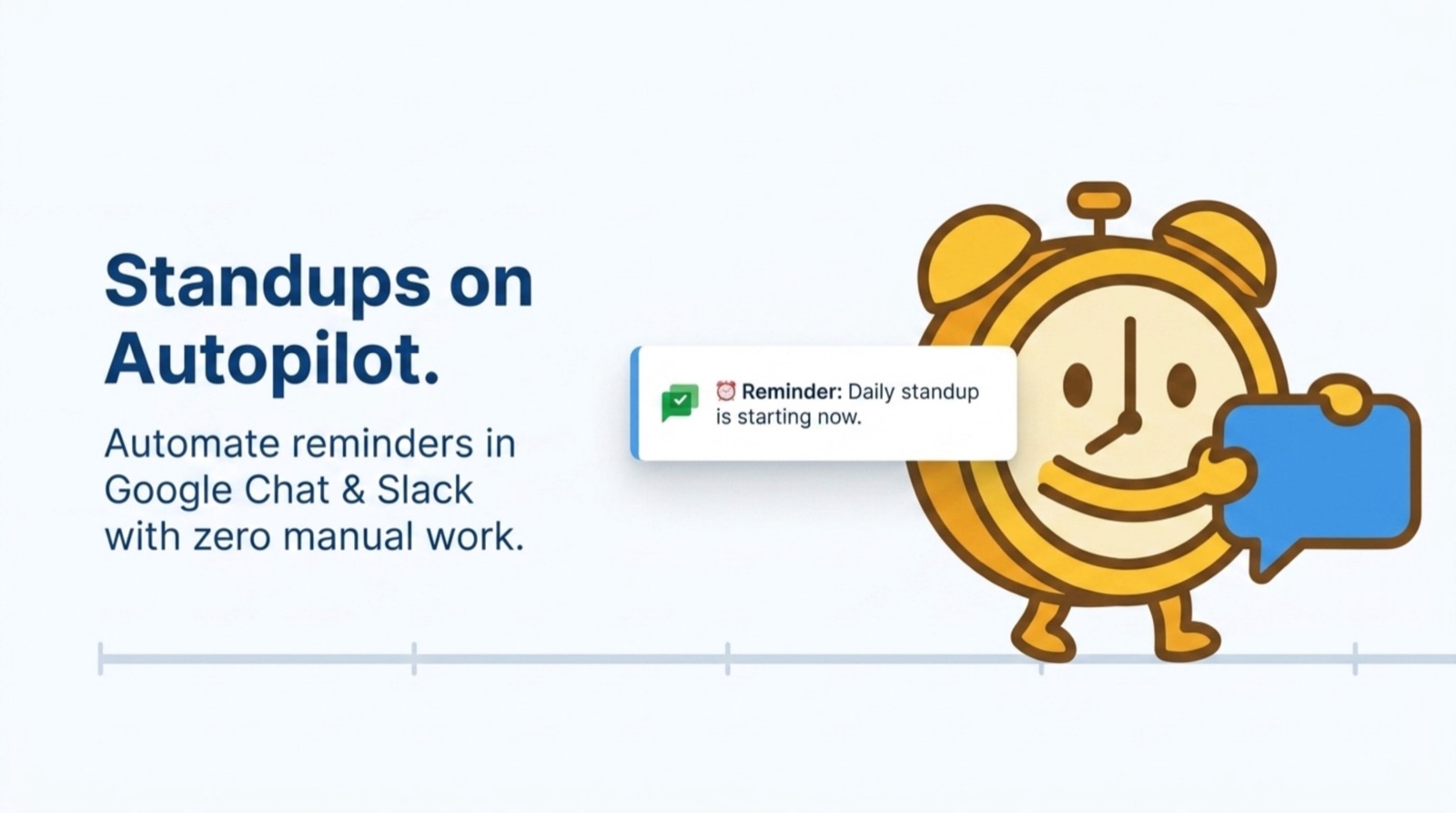
Typing "Good morning team! Please share your updates 🙏" every day is dread work. It takes thirty seconds, but it lives in your head rent-free every morning until you do it. And when you go on vacation, the routine falls apart.
Good news: you can automate your daily standups and recurring reminders entirely, without heavy enterprise tools or complex onboarding.
The problem with manual team reminders
It's not just standups. Think about every recurring message your team depends on:
- Daily standup prompts — "What are you working on today? Any blockers?"
- Weekly check-ins — "EOD Friday: drop your wins for the week 🏆"
- Sprint reminders — "Sprint ends tomorrow. Please update your tasks."
- Meeting prep nudges — "1:1 in 30 minutes — have your topics ready"
- Recurring announcements — "Reminder: no-meeting Wednesdays are sacred 🙏"
When you depend on a human to be the team's alarm clock, the routine inevitably fails. Distributed teams need rituals that don't rely on a single person being online and remembering to send a message. Automating these channel prompts removes the bottleneck.
Why do DM-based standup bots like DailyBot underperform?
Fair pushback: tools like DailyBot, Geekbot and Standuply already exist, and they do solve part of the problem. But there's a fundamental design choice in DM-based bots that I think gets it wrong: they run standups in private DMs.
Here's how it typically works: the bot DMs each person individually, asks "What did you do yesterday?", collects answers, then posts a compiled summary back into a channel. Sounds efficient on paper. In practice, it creates three real problems.
1. No social proof
When updates happen in a public channel, there's natural pressure to participate. You see Ravi already posted his at 9:02 AM. Then Priya adds hers. You think, "I should probably share mine too." That's social proof — the healthy kind that keeps teams accountable without managers having to nag.
In a DM-based flow none of that happens. You get a private message from a bot, and it feels like homework. There's no momentum, no sense of "the team is doing this together." It's just you and a robot in a chat window.
2. Bot DMs get reflexively ignored
Be honest with yourself — how many bot DMs do you actually read carefully? Most people develop a reflex: see bot message, swipe away. It's not malicious; it's how attention works. Bot messages don't carry the same weight as a message from a real person in a real channel.
On the teams I've watched migrate, DailyBot response rates often hover around 40–50%. The bot sends ten DMs, maybe five people respond, and the compiled "standup summary" is half-empty. At that point, what's the value of the ritual?
3. The compiled summary loses context
When DailyBot finally posts the compiled summary, it's a wall of text — bullet points from eight different people, stripped of conversation. Nobody replies to it. Nobody threads on it. It's a read-once-and-forget artifact.
Compare that to a standup that happens organically in a channel: someone posts a blocker, a teammate jumps in with "oh, I had that same issue — try X," and suddenly you've got a real conversation that actually unblocks work. That just doesn't happen with a bot-compiled digest.
Schedule Message vs DailyBot vs Google's native scheduler — at a glance
Before going deeper, here's the comparison teams actually want to see — what each option does and doesn't do for recurring messages in Google Chat:
| Feature | Schedule Message | Native | DailyBot / Geekbot | Send It Later |
|---|---|---|---|---|
| Recurring schedules | ✅ | ❌ One-off only | ✅ | ✅ |
| Posts in channel (not DM) | ✅ | ✅ | ❌ DM-first digest | ✅ |
| Posts as you (not a bot) | ✅ on paid plan | ✅ | ❌ Bot identity | ✅ |
| Custom recurrences (e.g. every other Friday, 4th Friday of the month) | ✅ | ❌ | Limited | ✅ |
| Pricing | Flat: $2.63/mo (1 user) · $14.25/mo (≤20) · $37.50/mo (∞) | Free, no recurrence | ~$2.50–4 / user / month | Paid only |
The takeaway: if you only ever send one-offs, Google Chat's native scheduler (rolled out December 2025) is enough. The moment you need anything to repeat — daily standups, weekly retros, sprint reminders — you need a tool. Among those, the channel-first ones (Schedule Message, Send It Later) tend to outperform the DM-first ones (DailyBot, Geekbot) because of the social-proof effect above.
How do you automate recurring messages without the clunky bot feel?
Here's what I think actually works: automate the message, not the workflow. Instead of a bot interrogating each person privately, just have the right message show up in the right channel at the right time. Then let humans be humans — they'll reply in thread, riff off each other's updates, and naturally hold each other accountable.
That's exactly what we built Schedule Message to do. It's deliberately small:
- Add the app to the space
- Type
/scheduleand type your message - Just watch it happen
| When | Use case | What you'd type |
|---|---|---|
| Weekday 9:00 AM | Daily standup | Morning team 👋 Drop your updates in thread — what you shipped, what's next, what's blocking. |
| Friday 4:00 PM | Weekly retro | 🔄 Friday retro — what worked this week, what didn't, and one thing we'll try differently next week? |
| Monday 10:00 AM | Sprint kickoff | 📋 New sprint starts today. Top priorities are pinned. Block your focus time and let's go. |
| Daily 5:30 PM | EOD wrap-up | 🌇 Wrapping up — share your wins, blockers, or anything teammates should see before tomorrow. |
| Birthdays / work anniversaries | Team rituals | 🎉 Happy work-anniversary, @Priya! Drop a memory or thank-you in this thread. |
That's it. The message shows up on schedule, every single time. No DMs. No compiled summaries. Just the right words, in the right place, at the right time.
The "send as you" trick
Here's the small detail that changes everything: Schedule Message can post under your name instead of as a bot. So when the standup prompt appears at 9 AM, it looks like you typed it. Your avatar, your name, your message.
Why does this matter? Because people respond to people. A message from "Neha Goyal" saying "Morning team! Share your blockers 👇" gets noticeably more engagement than a message from "🤖 StandupBot" saying the same words. Same prompt; the human element changes the response rate entirely.
The 'send as you' thing is the whole point. Previous tools posted as a bot and nobody replied. Now people actually thread back because it looks like I typed it.
— Daniel M., Ops Lead
What recurring messages do real teams (and people) automate in Google Chat?
Two flavours: recurring messages that go to a team space (standups, sprint prompts, peer shoutouts) and recurring messages you send to yourself in your own DM as a daily nudge (eat the frog, weekly priority setting, inbox zero). Steal any of these — seriously, we don't mind:
Team rituals (sent in a space)
Message Template
TemplateMorning team 👋 Quick standup — drop your updates in thread: 1. What are you working on today? 2. Any blockers? 3. Anything you need help with?" Weekdays at 9:00 AM
Message Template
TemplateHappy Friday! 🥂 Drop your biggest win of the week in the thread below." Every Friday at 1:00 PM
Message Template
TemplateSprint planning is tomorrow! Please make sure your Jira tickets are updated and story points are assigned. 🚀" Every Monday at 4:00 PM
Message Template
TemplateFriendly reminder: please log your hours and submit your timesheets before logging off today!" Every Friday at 3:00 PM
Message Template
TemplateWho is your team MVP this week? Tag them below and tell us why! 🌟" Every Friday at 2:00 PM
Message Template
TemplateFriendly reminder: it's no-meeting Wednesday. Protect your deep work time today. If something can wait until tomorrow, let it wait. 🙏" Every Wednesday at 8:30 AM
Personal nudges (sent to your own DM)
These are the ones people don't talk about as much, but they're often the most useful. You schedule them to land in your own DM with the bot — a quiet, recurring nudge that nobody else sees. Think of them as a calmer, more reliable replacement for the sticky notes on your laptop.
Message Template
TemplateWhat is your biggest, ugliest task today? Drop everything and do it right now. 🐸" Weekdays at 8:30 AM — the classic "eat the frog" / hardest-thing-first nudge.
Message Template
TemplateWhat are your top 3 non-negotiable priorities for this week? Write them down now." Every Monday at 8:00 AM — keeps the week from getting hijacked by other people's emergencies.
Message Template
TemplateSpend the next 15 minutes clearing out your emails and Chat messages before logging off. 📥" Weekdays at 4:30 PM — inbox-zero sprint, so you start the next morning fresh.
Message Template
TemplatePick the one thing you'll actually be proud of shipping today. Then go do it." Weekdays at 9:30 AM — a daily motivation reminder that's a little harder to swipe away than a sticky note.
Message Template
TemplateNew month, new retro. Before Thursday's session, jot down: • What went well last month? • What could we improve? • Any shoutouts for teammates?" First Monday of the month at 9:00 AM
When should you use Google Chat's built-in scheduler instead?
Google rolled out native message scheduling in Google Chat in December 2025. It's a real feature — open the compose box, hold the send button, pick a date and time. It's also limited: each scheduled message is a one-off. There's no recurrence, no time-zone setting beyond your own, and no "send as someone else."
Use the native scheduler when:
- You're sending a one-off announcement that needs to land at a specific moment (e.g., a launch reveal at 10 AM tomorrow).
- You're catching up on Slack-style "send this email later" habits — drafting a non-urgent question at midnight, scheduled for the morning.
- You don't want any third-party tool installed in your Workspace.
Reach for a recurring scheduler the moment any of these are true: the message repeats (daily, weekly, every other week), it needs to land at the same local time for teammates in different time zones, or it needs to look like it came from a person rather than a faceless app.
Why channel-based reminders beat DM bots (the short version)
Short summary of why a scheduled prompt in a public channel consistently beats a DM-first standup bot:
- Social proof drives participation. When you see teammates replying in thread, you're more likely to reply too. Nobody wants to be the one person who didn't post.
- Conversations happen naturally. Blockers get discussed. Ideas get built on. That doesn't happen when updates are isolated in private DMs.
- Human names beat bot names. A message from your team lead at 9 AM feels different from a bot DM. People engage more with messages from real people — even when those messages are scheduled.
- Zero onboarding for the team. Nobody has to learn a new bot's commands. The message just appears in their channel. They reply in thread. Done.
- Works even when you're away. Schedule Message sends on schedule whether you're online, offline, or on vacation. The standup happens without you being the bottleneck.
How do you set up Schedule Message in Google Chat?
I know every product says "set up in minutes" and then you're Googling error messages for an hour. This one's actually fast:
- Install Schedule Message from the Google Workspace Marketplace (about ten seconds).
- Open Google Chat, go to any space, and type
/schedule. - Write your message, choose a recurrence (daily, weekly, every two weeks, custom cron), and hit Schedule.
- That's it. Tomorrow morning, the message sends itself. And the day after that. And the day after that.


There's a free-forever tier — unlimited one-time messages plus 1 concurrent recurring schedule — so you can run a ritual without committing. Paid plans are flat-rate — $2.63/month for a single user, $14.25/month for up to 20 users, and $37.50/month for unlimited members. No per-user math: the price you pay at 5 users is the same as 50 or 500. See pricing and what's in each plan →
Frequently asked questions
Frequently asked questions
Can you send recurring messages in Google Chat natively?
Is there a free Google Chat scheduler with recurrence?
How is Schedule Message different from DailyBot or Geekbot?
How do I send the same message every day in Google Chat?
/schedule in any space, write the message, and pick a recurrence. Takes about 30 seconds.Can I make a Google Chat message repeat every week or every Monday?
How do I automate sending messages in Google Chat?
Does it support time zones for distributed teams?
Can I edit, pause, or delete a recurring schedule?
/schedule menu in any space and you can edit the message, change the recurrence, pause it (e.g., during a holiday week), or delete it without losing the rest of your scheduled messages.Will the message still send if I'm on vacation?
Stop being your team's alarm clock
The standup message isn't hard to write. It's hard to remember to write every single day, without fail, for months on end. It's the kind of task that slowly drains your energy — not because it's difficult, but because it's relentless.
Automate it. Set it once. Forget about it. Spend those thirty seconds of your morning on something you actually enjoy — like coffee, or pretending to read that article your CEO shared in #general.
Your team will still get their standup prompt at 9 AM sharp. They'll still reply in thread. The only difference is that you won't be the one sending it anymore.
And honestly? Nobody will even notice. Which is kind of the best part.